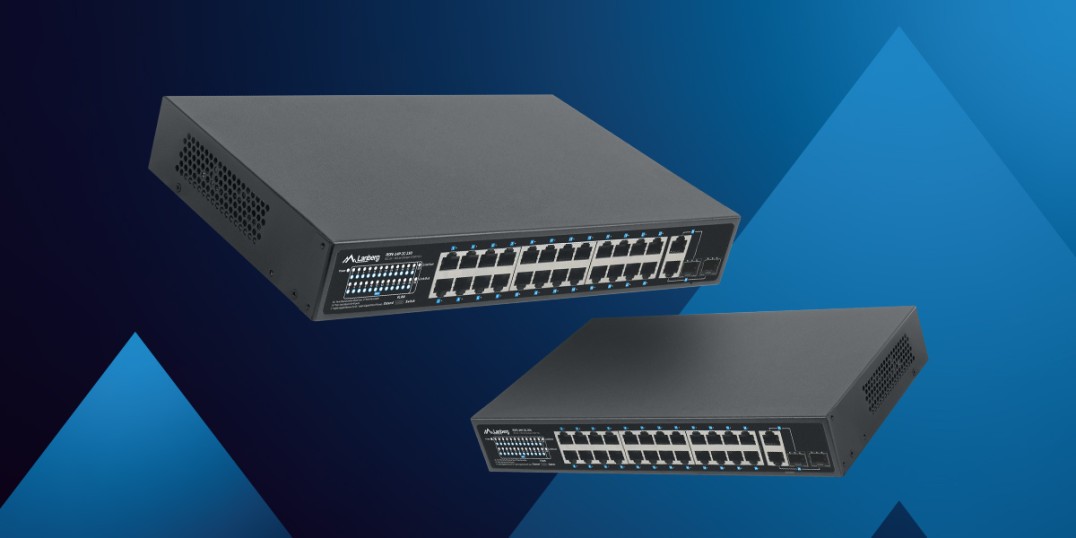
What is a PoE switch and how does it make building a modern network easier?
When you are planning a network in an office, school, production hall, or parking lot, sooner or later you run into the question: where do you get power for cameras, access points, and card readers? Running 230V power lines to every device can be expensive, troublesome, and often simply impossible without breaking through walls. A PoE switch solves this problem in a simple way.
What is a PoE switch and how is it different from a regular switch?
A network switch is a device that connects different pieces of equipment into one local network. It transfers data between them, manages traffic, and ensures that packets reach the right destination. It is the foundation of every network, regardless of size. A regular switch does only that: it transfers data. Every device connected to such a network must have its own power supply, a separate cable, or a power adapter.
A PoE switch does exactly the same thing as a regular switch, but at the same time it delivers power through the same cable that carries the data. PoE stands for Power over Ethernet. One cable to the device instead of two.
The principle is simple. A Category 5e or higher twisted-pair cable has eight wires arranged in four pairs. A PoE switch uses those same wires simultaneously for data transmission and direct-current power delivery. Importantly, before turning the power on, the switch checks whether the connected device actually supports PoE. Thanks to this, accidentally connecting a regular laptop or printer to a PoE port does not risk any damage.

What devices can be powered via PoE?
Practically any network device that operates on low-voltage power and does not consume too much power. The list is long and still growing.
IP cameras are by far the most common application. From simple dome cameras to advanced PTZ cameras used in large monitoring systems. The former are satisfied with a few watts, while the latter may need several dozen. That is why, when choosing a PoE switch for surveillance, it is worth paying attention to which standard and how much power each port supports.
Wi-Fi access points are the second major area of use. An access point is installed where coverage is needed, not where there happens to be an electrical outlet. PoE removes that limitation completely. Modern Wi-Fi 6 access points, which draw quite a lot of power, especially benefit from ports with higher power standards.
VoIP phones have used PoE since the very beginning of this technology. A desk phone is rarely placed right next to an electrical outlet, and with PoE, one cable to the desk is enough and the phone simply works.
Access control systems are another category: proximity card readers, electromagnetic locks with a network interface, intercom panels, entrance cameras. These are devices that naturally end up in places without nearby electrical outlets.
In addition, PoE can power alarm sensors with a network interface, industrial IoT controllers, information displays, outdoor IP speakers, or small routers. Anywhere a network device operates far from electrical infrastructure, PoE makes life easier.

Why does PoE simplify installation so much?
Imagine installing eight cameras on the outer walls of a building. Without PoE, each camera needs its own power supply: either you run a 230V cable from the electrical distribution board, or you install a separate power adapter somewhere near each camera. The cost and labor increase with every additional point.
With a PoE switch, the situation looks completely different. You run one cable to each camera, and that cable both transmits the image and powers the device. You do not need an electrician at every mounting point, you do not design a distribution board with a dozen branches, and you do not buy a dozen external power supplies that still need to be placed somewhere.
The savings are real on several levels at once. Less material, because one cable replaces two. Less labor, because one groove in the wall or one in-wall cable run is enough for each point. Less clutter in the cabinet, because you eliminate the forest of power strips and splitters.
There is also one aspect that is rarely talked about but in practice turns out to be very convenient. Managed PoE switches allow you to remotely restart connected devices without leaving the office. Did a camera freeze during the night? Just turn the power off and on for the specific port through a browser.
PoE standards, or how much power you can transmit
Not every PoE switch offers the same power. This is one of the most important things worth understanding before purchase.
- The basic IEEE 802.3af standard, usually called simply PoE, provides a maximum of 15.4W per port. It is enough for simple cameras and VoIP phones, but modern devices often need more.
- The IEEE 802.3at standard, or PoE+, raises the limit to 30W per port. That is enough for most access points and more advanced IP cameras.
- The IEEE 802.3bt standard, known as PoE++ or PoE bt, is a completely different league. Depending on the version, it allows 60W or even 90W per port. For installers working with demanding devices, this is an important threshold: only this standard allows you to freely power PTZ cameras with heating, advanced next-generation access points, or small industrial computers.
Manufacturers of networking equipment, including Lanberg, are developing their portfolios precisely toward higher PoE classes, responding to the growing demand for power in modern installations.
Where do PoE switches work best?
Video surveillance is by far the largest market. CCTV systems in shopping centers, parking lots, factories, and along public roads are now overwhelmingly based on IP cameras powered via PoE. This makes it possible to build extensive installations without running additional electrical infrastructure to every point.
Wi-Fi networks in offices, hotels, hospitals, and halls are the second huge area. Access points are installed where they are needed, not where there is an outlet. For larger facilities, this is the difference between an aesthetically clean installation and a tangle of cables and power strips.
IP telephony is still an important part of corporate installations. Desk phones, gateways, and VoIP PBXs have used PoE for years, and it works flawlessly.
Access control and security systems are an area that is growing together with building automation. Card readers, network locks, and intercom panels naturally end up in places without nearby outlets.
In industrial and outdoor environments, there is one more dimension: the switch has to operate reliably across a wide temperature range, often without air conditioning and in conditions that have nothing in common with a server room. This is a separate category of devices that the company says it will return to in future articles.

PoE switch as the foundation of a modern network
Power over Ethernet technology started with a simple idea: why run two cables when one is enough? More than twenty years after the first PoE standard was introduced, it has become a permanent part of every more serious network installation, and it is hard to imagine modern surveillance or a Wi-Fi network without it.
For the installer, it means concrete savings in time and materials. For the network administrator, it means convenient control of device power from one place. For the investor, it means lower construction costs and easier expansion in the future.
If you are planning a network that has to power cameras, access points, or IP phones, a PoE switch stops being an option and becomes the obvious choice. The question is no longer “whether,” but “which PoE standard will be appropriate for the specific devices and installation conditions,” and that is exactly what the next article in the series will be about.